
Imagine turning global economic shifts into profitable opportunities from your desktop. The Forex market, with its $7.5 trillion daily volume per Bank for International Settlements data, offers beginners unprecedented access to currency trading.
This guide demystifies essentials-from market basics and major pairs to leverage, risk management, and modern trends like AI trading-equipping you to trade confidently. Discover your next steps inside.
What is Forex Trading?
Forex trading involves speculating on currency pair price movements, such as buying EUR/USD when expecting euro strength against USD. It operates as an over-the-counter market for spot, forwards, and swaps. Traders exchange one currency for another to profit from rate changes in the FX market.
The three main types include spot trading, forwards, and futures. Spot deals settle almost immediately at the current rate and dominate activity. Forwards and futures set future delivery prices, often used by institutions for hedging.
- Spot trading: Immediate exchange at the prevailing bid price or ask price.
- Forwards: Customized contracts between parties for a future date.
- Futures: Standardized contracts traded on exchanges like CME Group.
Consider buying 1 standard lot of EUR/USD at 1.1000 and selling at 1.1050 for a $500 profit. Each pip equals $10 per standard lot, so 50 pips yield that gain. Beginners can practice this on a demo account with platforms like MetaTrader 4.
Why Currency Trading Matters Today
With smartphone apps and $100 minimum deposits, forex now attracts millions of retail traders worldwide. Mobile trading has democratized access to the FX market, letting beginners trade major pairs like EUR/USD from anywhere. This shift opens doors for everyday people to engage in currency trading.
Retail forex grew 25% year-over-year per ESMA data, showing rising interest in online trading. Platforms like MetaTrader 4 on mobiles handle much of the retail volume. Beginners can practice on a demo account before risking real money.
Inflation hedging draws traders as currencies like the USD strengthen against weakening ones. During tough times, such as the 2022 naira crisis, a Nigerian trader used mobile MT4 to earn passive income via spot trading. This real example highlights forex’s role in portfolio diversification.
Adding currency pairs to investments spreads risk beyond stocks or bonds. Experts recommend mixing major pairs with exotic pairs for balance. In today’s global economy, currency trading today offers practical ways to protect and grow wealth.
The Forex Market Basics
The decentralized forex market operates 24/5 across major centers like London (43% volume), New York (19%), Tokyo (BIS 2022). This over-the-counter structure differs from centralized stock markets, allowing continuous currency trading without a single exchange. Beginners benefit from its massive scale and high liquidity.
Key trading sessions drive activity, with London from 8am to 5pm GMT leading in volume. Overlaps, such as London-New York, boost liquidity and tighten spreads. This setup helps newcomers avoid slippage, where orders execute at worse prices during low-volume times.
The market’s 24/5 nature suits various schedules, from scalping during sessions to swing trading over days. Participants range from banks to retail traders, ensuring deep liquidity. For beginners, this means reliable entry and exit for spot trading positions.
Unlike stocks, forex’s OTC model relies on interbank networks for quotes. Retail traders access it via forex brokers on platforms like MetaTrader 4 or 5. Start with a demo account to practice in real market conditions without risk.
Market Structure and Participants
Top participants include banks (50% volume – JPMorgan, Citi), hedge funds (15%), corporates (10%), retail (5%) per BIS. The tiered structure flows from Tier 1 banks to ECNs, then brokers, and finally retail traders. This hierarchy ensures efficient price discovery in the FX market.
Volume peaks by session: London 32%, New York 17%, Tokyo 7%. Retail traders gain access through STP/ECN brokers, which connect directly to liquidity providers. This reduces manipulation risks and offers transparent execution.
| Participant | Role | Approx. Volume Share |
| Banks | Primary liquidity providers | 50% |
| HFT Firms | High-speed algorithmic trading | 20% |
| Retail Traders | Individual speculators | 5% |
Beginners should choose regulated forex brokers under bodies like FCA or CFTC. Practice on a demo account to understand how retail orders fit into this structure. Focus on high-liquidity hours to minimize costs.
Major Currency Pairs
Majors like EUR/USD (28% volume), USD/JPY (17%), GBP/USD (12%) offer tight spreads (0.5-1 pip) and high liquidity. These currency pairs dominate forex trading, ideal for beginners due to low costs and predictable moves. Trade them during active sessions for best results.
Top majors include EUR/USD with 1.1 pip average spread during London/NY overlap. Others like USD/CHF, AUD/USD, USD/CAD, and NZD/USD follow suit. EUR/USD often moves 80 pips daily on average, providing clear opportunities for day trading or scalping.
| Pair | Avg. Spread (Pips) | Best Trading Time | Pip Value (Standard Lot) |
| EUR/USD | 1.1 | London/NY overlap | $10 |
| USD/JPY | 0.8 | NY/Tokyo overlap | $10 |
| GBP/USD | 1.2 | London session | $10 |
For a standard lot (100,000 units), one pip equals $10 on most majors. Use technical analysis tools like moving averages on candlestick charts to spot trends. Beginners can backtest strategies on these pairs for confidence before going live.
Exotic and Minor Pairs
Minors like EUR/GBP, exotics like USD/TRY (200+ pip spreads) suit advanced traders seeking volatility (USD/ZAR: 300 pip daily range). Minor pairs exclude USD but keep spreads at 1-3 pips, while exotic pairs involve emerging currencies with wider spreads. Beginners should stick to majors first.
Minors offer diversification without extreme costs, such as EUR/AUD during European sessions. Exotics carry higher swap fees due to rollover interest differences. USD/TRY surged 30% in 2023 due to Turkish policy, showing their potential for big swings.
| Pair | Avg. Spread (Pips) | Volatility | Best For |
| EUR/GBP (Minor) | 1-2 | Medium | Swing trading |
| USD/TRY (Exotic) | 200+ | High | Volatility plays |
| USD/ZAR (Exotic) | 50-100 | Very High | Experienced traders |
Watch for economic indicators like interest rates on exotics, as they amplify moves. Use tight risk management with stop losses to protect capital. Demo trade minors to build skills before tackling exotics’ challenges.
How Currency Trading Works
Traders profit from 1-pip moves equaling $1 per micro lot, $10 per mini lot, $100 per standard lot across 28 major pairs in the FX market. The core idea in currency trading is to buy low and sell high on currency pairs like EUR/USD or GBP/JPY. You speculate on exchange rate changes driven by economic news or market sentiment.
Leverage multiplies your exposure, letting small accounts control large positions in this 24/5 market. For example, with 1:100 leverage, a $1,000 account handles $100,000 worth of currency. This amplifies both profits and losses, so beginners should practice on a demo account first.
Understand position sizing to manage risk in forex trading. Profit calculation follows: (exit price – entry price) x pip value x lot size. A 50-pip gain on a mini lot at $10 per pip yields $500, minus spreads and swaps.
Master the pip before live trading on platforms like MetaTrader 4 or MetaTrader 5. One pip is the smallest price move, often the fourth decimal in major pairs. Test strategies with technical analysis tools like candlestick charts and moving averages on minor or exotic pairs too.
Bid, Ask, and Spread Explained
EUR/USD bid 1.1000 (sell price), ask 1.1002 (buy price) equals a 2 pip spread; profit when price moves beyond spread in spot trading. The bid is what your forex broker pays to buy from you, ask is what they charge to sell to you. This difference, the spread, is the broker’s fee.
Visual example: Quote 1.1050/1.1053 means buy at 1.1053, sell at 1.1050. Long entry at 1.1053 to exit at 1.1073 gains 20 pips x $10 per pip on a mini lot = $200. Short trades reverse this logic for bearish views.
| Currency Pair | Average Spread (Pips) |
| EUR/USD | 1.0 |
| GBP/USD | 1.5 |
| USD/JPY | 0.8 |
Compare broker spreads for pairs like AUD/USD or USD/CAD, as they vary by liquidity and volatility. Tighter spreads on major pairs suit day trading or scalping. Always check during high-volume market hours like London-New York overlap.
Leverage and Margin Basics
1:100 leverage controls $10,000 with $100 margin (1% requirement) on EUR/USD, amplifying a 10-pip move to $100 profit or loss in currency exchange. Margin is the deposit to open positions, calculated as position size / leverage. It keeps your account funded against losses.
Formula: Margin = Position Size / Leverage. A $10,000 mini lot at 1:50 needs $200 margin. EU rules cap at 1:30 leverage for retail traders, while offshore brokers offer up to 1:1000, increasing risk.
| Leverage | Margin Req. for $100k | Risk per Pip (Standard Lot) |
| 1:30 | $3,333 | $100 |
| 1:100 | $1,000 | $100 |
| 1:500 | $200 | $100 |
A margin call hits at 50% drawdown, forcing position closure for capital preservation. Use stop loss orders and position sizing to avoid this in volatile pairs like GBP/JPY. Regulators like FCA enforce protections for beginners.
Long vs. Short Positions
Long EUR/USD at 1.1000 expecting euro strength, short USD/JPY at 150.00 betting yen appreciation defines long position (buy base currency) vs short position (sell base). In EUR/USD, base is EUR, quote is USD. Go long in bull markets, short in bear markets.
P/L calculation: Long +50 pips = profit, short -30 pips = loss on matching lot sizes. For a mini lot, +50 pips long yields $500, while short needs price to fall for gains. Factor in swap fees or rollover, often 3x higher long EUR/USD vs short due to interest rates.
Scenarios: Long AUD/USD on strong commodity prices, short NZD/USD if bearish on risk appetite. Use economic indicators like GDP or central bank news from Federal Reserve or ECB. Combine with risk management like 1% account risk per trade and trading psychology discipline.
Hedging with correlated pairs like EUR/GBP reduces exposure. Practice on demo accounts to grasp order types such as market or limit orders before live currency trading today.
Key Tools for Trading
MetaTrader 4/5 power most retail forex volume with one-click trading and 50+ indicators. These platforms offer real-time quotes, advanced charting, and auto-trading features essential for currency trading. Beginners benefit from free demo access to practice without risk.
Most platforms include mobile compatibility for trading on the go. Set up a demo account in minutes by choosing a forex broker, downloading the app, and verifying your email. This lets you test strategies on major pairs like EUR/USD before going live.
Key tools also cover economic calendars and news feeds for fundamental analysis. Use demo accounts to learn order types such as market orders and stop losses. Mobile apps ensure you stay connected during high-volatility sessions in the 24/5 FX market.
Experts recommend starting with demo trading to build discipline and understand leverage risks. Practice position sizing with micro lots to preserve capital. These tools make modern forex accessible for beginners today.
Trading Platforms Overview

Trading platforms form the backbone of currency trading, providing tools for spot trading currency pairs. They offer real-time bid price, ask price, and spread data for majors like USD/JPY and minors like GBP/AUD. Beginners should prioritize user-friendly interfaces with demo accounts.
| Platform | Cost | Spreads (EUR/USD) | Instruments | Mobile | Best For |
| MT4 | $0 | 0.1 pip | Forex+CFDs | Yes | Beginners |
| MT5 | $0 | 0.0 pip | Forex+Stocks | Yes | Advanced |
| cTrader | $0 | 0.0 pip | ECN | Yes | Scalpers |
| TradingView | $15/mo | Varies | Forex+Social | Yes | Community |
| Thinkorswim | Free | Varies | Advanced | Yes | Analysis |
Setup for MT4 takes under 5 minutes: download from your broker, log in with demo credentials, and customize charts. Many brokers support MT4 for its simplicity in handling lot sizes from micro to standard. This makes it ideal for learning trading basics.
Choose based on your style, like cTrader for scalping during high liquidity hours. Test mobile versions for day trading GBP/USD volatility. Platforms like these support risk management with stop loss and take profit orders.
Charts and Technical Indicators
Use 50 EMA + 200 EMA crossover, known as the golden cross, on H4 EUR/USD charts for trend confirmation. This moving averages setup signals long positions in bull markets. Combine with candlestick charts for precise entry points on support levels.
Essential indicators include:
- Candlesticks (default timeframe) to spot reversal patterns like doji or hammer.
- SMA20/50 for short-term trend lines on minor pairs.
- RSI14 (>70 overbought, <30 oversold) to avoid chasing tops.
- MACD(12,26,9) for momentum shifts on JPY crosses.
- Bollinger Bands(20,2) to gauge volatility squeezes.
- Fibonacci retracement (38.2%, 61.8% levels) for pullback trades.
- Volume to confirm breakouts on AUD/USD.
Example: On EUR/USD H1, spot RSI divergence + support bounce for a buy signal. Draw Fibonacci from recent swing low to high. Free TradingView templates speed up this technical analysis process.
Practice these on demo accounts to master swing trading strategies. Pair with economic indicators like interest rates from the ECB for context. This approach helps beginners manage greed and fear in the foreign exchange market.
Factors Driving Currency Prices
Non-Farm Payroll beats, such as 200k vs 150k expected, strengthen the USD 50-100 pips immediately. Fundamentals move markets long-term in currency trading, while news creates volatility. Beginners should track these shifts using an economic calendar.
Key releases like NFP on the first Friday, CPI, and GDP drive forex trading reactions. Strong data boosts the reporting currency, while weak figures weaken it. Traders check calendars from sites like Forex Factory for high-impact events marked in red.
News volatility offers opportunities but risks for beginners. Use a demo account to practice reactions without real capital. Combine this with fundamental analysis for better currency pair decisions.
Monitor market hours when events hit, as liquidity peaks during London-New York overlap. This setup helps grasp spot trading dynamics in the FX market.
Economic Indicators
NFP above 200k expected equals USD +1-2%; CPI at 0.2% over forecast signals hawkish Fed pricing. These economic indicators shape currency exchange trends in the foreign exchange market. Track them via economic calendars for timely trades.
| Event | Currency | Impact | Example Reaction |
| NFP | USD | High | +80 pips |
| GDP | All | High | EUR -50 pips weak data |
| Retail Sales | USD, EUR | Medium | GBP strengthens on beat |
| PMI | All majors | High | JPY rally on strong Japan print |
| Unemployment | USD, EUR | High | AUD dips on rising rate |
| CPI | All | High | USD up on hot inflation |
| Trade Balance | CAD, AUD | Medium | NZD gains surplus |
| Consumer Confidence | USD | Medium | CHF safe-haven on drop |
Forex Factory rates these with colors: high impact in red. Beginners focus on majors like USD pairs first. Practice spotting pip moves on MetaTrader 4.
Weak GDP data often sends major pairs lower, signaling broader slowdowns. Pair this with technical analysis like support levels for entries.
Interest Rates and Central Banks
Fed rate hike in 2022 pushed USD index +15%; BOJ yield curve control drove USD/JPY past 150 in 2023. Central bank policies dominate currency trading today. Interest rates attract capital to higher yielders.
Carry trade example: go long AUD/JPY with Australia at 3% versus Japan near 0%. Policy divergence, like hawkish Fed against dovish ECB, fuels USD strength. Watch FOMC eight times yearly, ECB and BOJ similarly.
Forward guidance from meetings sways markets more than rates alone. Traders parse statements for hints on future hikes. Use trading platforms to check decision calendars.
- FOMC: Focus on dot plot updates.
- ECB: Inflation target shifts.
- BOJ: Yield cap changes.
Dovish tones weaken currencies, aiding short positions. Beginners preserve capital with stop loss orders during these events.
Geopolitical Events
Russia-Ukraine in 2022 saw EUR -10%, USD safe-haven up 7%; Brexit dropped GBP/USD 15% peak-to-trough. These shocks spike volatility in FX market. Risk sentiment flips currency flows fast.
Safe havens like USD, JPY, CHF rally in crises; risk-on pairs AUD, NZD, CAD fall. US-China trade war pushed USD/CNY to 7.2, elections hammered MXN. Track via risk indices for sentiment.
Examples show patterns: wars boost major pairs toward safety. Beginners avoid overtrading by waiting for calm. Hedge with correlated assets like gold.
Use economic calendar for event risks alongside news feeds. Set position sizing small during uncertainty to protect accounts. This builds discipline in trading psychology.
Getting Started as a Beginner
Start with $100 demo on regulated brokers like OANDA or IG before risking capital. This approach lets beginners explore currency trading without financial loss. Focus on major pairs like EUR/USD and GBP/JPY to build confidence.
Follow this step-by-step path: select a broker, open a demo account for three months, transition to a micro account, and commit to ongoing education. Experts recommend at least 100 demo days to track progress. Practice helps grasp concepts like pip values, spread, and leverage.
After demo practice, move to a live micro account with small lot sizes, such as micro lots of 1,000 units. Keep a trading journal to note wins, losses, and strategies. This builds discipline and prepares you for the FX market’s volatility.
Combine technical analysis with tools like candlestick charts and moving averages during practice. Understand risk management by setting stop loss and take profit orders on every trade. Patience in this phase preserves capital for live forex trading.
Choosing a Reliable Broker
Compare brokers by regulation, execution type, and funding options when starting currency trading. Prioritize Tier 1 regulators like FCA or CFTC over others such as ASIC. Avoid red flags like unregulated status or bonus promises that often hide poor service.
| Broker | Regulation | Min Deposit | Spread EUR/USD | Leverage |
| OANDA | CFTC/NFA | $0 | 1.0 pip | 1:50 |
| IG | FCA | $250 | 0.6 pip | 1:30 |
| Pepperstone | ASIC | $200 | 0.0 pip | 1:500 |
Check verified spreads on platforms like Myfxbook for ECN brokers versus market makers. ECN execution offers tighter spreads for spot trading in pairs like USD/JPY. Test funding methods such as bank transfers or cards for ease.
Look for brokers supporting MetaTrader 4 or 5 with mobile trading apps. Ensure low swap fees for overnight positions in minor pairs like AUD/CAD. This setup supports beginner strategies like day trading during high liquidity hours.
Opening a Demo Account
Follow these numbered steps to set up quickly: 1) Select broker (OANDA), 2) Register email, 3) Download MT4, 4) Login demo server, 5) Fund virtual $10,000 (5 mins total). This simulates real forex trading conditions. Practice with currency pairs like EUR/USD to learn bid price and ask price.
- Choose a MT4 broker with strong regulation.
- Complete email verification for security.
- Download the trading platform from the broker site.
- Login using the demo server, such as OANDA-Demo.
- Place at least 100 trades tracking win rate above 55% before going live.
A common mistake is practicing without a journal to log entries, exits, and reasons. Use the demo to test order types like market orders and limit orders. Build habits in position sizing to manage margin on mini or micro lots.
Focus on one strategy, such as scalping major pairs during London session. Monitor economic calendars for events affecting volatility in GBP or JPY. This phase teaches trading psychology and avoids overtrading pitfalls.
Essential Education Resources
Babypips.com School (free, 300+ lessons), Investopedia simulator, Forex Factory calendar serve as starting points for most traders. These cover trading basics from currency exchange to advanced technical analysis. Beginners gain knowledge on support resistance and trend lines.
- Babypips for beginner to advanced path on fundamental analysis.
- Bookmap Heatmap free trial for order flow visualization.
- TradingView paper trading to test candlestick patterns.
- CME Group tutorials on futures and economic indicators.
- Broker webinars like IG Academy for live strategy sessions.
Follow a 3-month curriculum: weeks 1-4 on basics like pip and lot size, 5-8 on indicators such as RSI and MACD, 9-12 on risk management with stop loss. Practice economic calendar events from central banks like Federal Reserve or ECB. Integrate currency strength meters for pair selection.
Track progress with backtesting simple strategies on historical data. Avoid beginner mistakes like ignoring correlation between AUD and commodities. These resources build a solid foundation for live currency trading today.
Trading Strategies for Newbies
Beginner win rate doubles using simple EMA crossover vs. random entries, as verified on Myfxbook. New traders in currency trading benefit from mechanical rules with backtested edges. Always risk 1% per trade to protect your account.
Demo test each trading strategy for at least 100 trades before going live. This builds confidence in forex trading setups like trend following or scalping. Use a demo account on platforms such as MetaTrader 4 or MetaTrader 5.
Focus on major pairs like EUR/USD or GBP/USD for better liquidity and tighter spreads. Combine technical analysis tools such as moving averages and RSI with strict risk management. Patience and discipline separate successful beginners from the rest.
Track your trades in a journal to review position sizing and outcomes. Avoid overtrading by sticking to predefined rules. This approach supports steady growth in the FX market.
Trend Following Basics
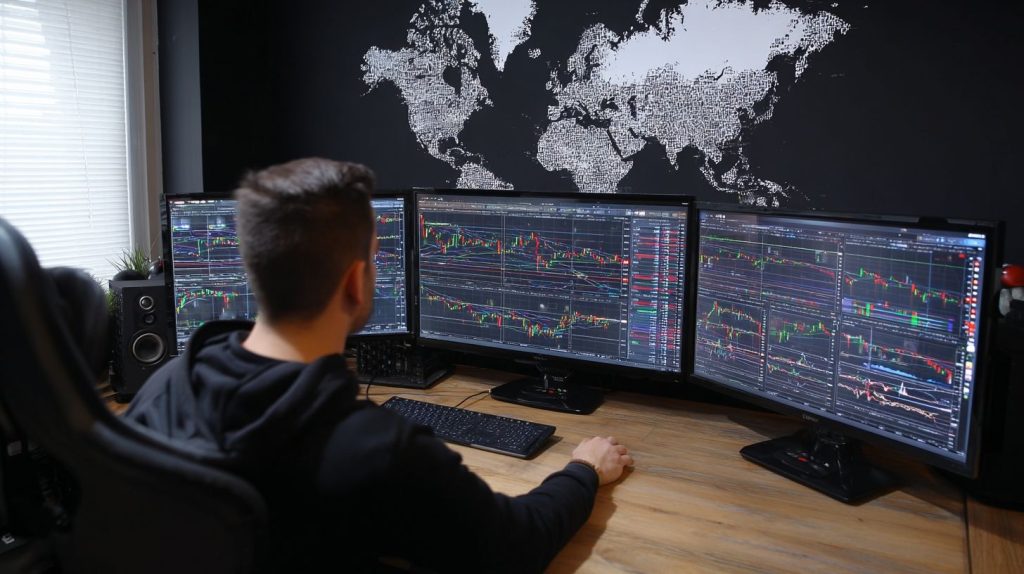
Enter EUR/USD long when price > 50 EMA + 200 EMA bullish crossover on H4 chart. This golden cross signals a strong uptrend in currency pairs. Confirm with higher timeframe like D1 for added reliability.
Wait for a pullback to EMA20, then check RSI > 50 to avoid false signals. Set 1:2 risk-reward ratio with stop loss below recent swing low and take profit at next resistance. For example, a 2023 GBP/USD trend captured +800 pips using these rules.
- H4 50/200 EMA golden cross.
- Pullback to EMA20.
- RSI > 50.
- 1:2 R:R with stop loss and take profit.
Backtest this on historical candlestick charts using your forex broker’s tools. Practice on a demo account to master swing trading in trending markets. Higher timeframe confirmation reduces whipsaws in volatile conditions.
Scalping and Day Trading
5-min EUR/USD scalping: Buy at London open + Bollinger squeeze, target 10 pips, 5-10 trades daily. This high-probability setup exploits short-term volatility in major pairs. Use M1 or M5 charts for quick entries.
For day trading, limit to 2-3 trades with no overnight positions to avoid swap fees. Target 5-15 pip moves on support bounces or breakouts. Choose a low spread broker under 0.5 pips with fast execution.
- Scalp during high liquidity like London or New York sessions.
- Set tight stop losses at 5 pips max.
- Aim for consistent small wins over home runs.
Test for a win rate target above 65% through backtesting and forward testing. Monitor market hours for peak volatility in pairs like USD/JPY or AUD/USD. Discipline prevents turning scalps into larger losses.
Risk Management Essentials
Experts recommend never risking more than 1-2% of your account per trade to preserve capital in currency trading. This core rule helps beginners avoid quick wipeouts in the FX market. A minimum 1:2 risk-reward ratio ensures potential profits outweigh losses over time.
Position sizing follows a simple formula: Position Size = (Account Balance x Risk Percentage) / (Stop-Loss Distance in Pips x Pip Value). For a $10,000 account risking 1%, you limit loss to $100 per trade. This approach fits any trading platform like MetaTrader 4 or 5.
Always combine these rules with stop-loss orders and disciplined journaling. Beginners often overlook trading psychology, leading to emotional decisions. Focus on capital preservation to trade longer in volatile currency pairs like EUR/USD or GBP/JPY.
Practice on a demo account first to test these essentials. Track major pairs during high liquidity hours for better results. Consistent application builds confidence in spot trading.
Stop-Loss and Take-Profit Orders
Long EUR/USD at 1.1000: place SL at 1.0980 (20 pips), TP at 1.1040 (40 pips) for a 1:2 risk-reward. These stop-loss and take-profit orders automate exits in forex trading. Use them on every trade to protect against sudden volatility.
Order types include market orders for instant execution, limit orders at specific price targets, and stop orders for breakouts or SL. Place stops using 14-period ATR x 1.5 for dynamic levels based on recent volatility. This suits major pairs like USD/JPY during economic news.
For examples, set SL below support levels or recent swing lows. Target TP at Fibonacci retracements like the 161.8% extension. Always confirm with candlestick charts and trend lines.
Enable these on your forex broker platform to enforce discipline. Avoid moving stops wider due to greed or fear. This protects your live account in the 24/5 currency market.
Position Sizing Rules
For a $10k account, 1% risk ($100), 20-pip SL equals 0.5 mini lots with $50 per pip risk in currency trading. This position sizing formula prevents oversized trades: Position Size = (Account x Risk%) / (SL Pips x Pip Value). Adjust for lot sizes like standard, mini, or micro.
| Account Size | Risk % | SL Pips | Position Size |
| $5,000 | 1% | 30 | 0.17 lots |
| $10,000 | 1% | 20 | 0.5 mini lots |
| $20,000 | 1% | 40 | 0.50 lots |
Use fixed fractional for steady risk or volatility-adjusted with ATR for pairs like AUD/USD.
Test calculations on a spreadsheet for major pairs, minor pairs, or exotics. Factor in leverage up to 1:30 and margin requirements from your broker. This keeps risk consistent across long positions or short positions.
Beginners benefit from demo accounts to master sizing before live trading. Pair with technical analysis tools like moving averages or RSI. Proper sizing supports strategies like day trading or swing trading.
Common Risk Pitfalls
Overtrading with too many trades daily often leads to faster losses than selective setups in forex trading. Revenge trading after losses compounds mistakes for many accounts. Avoid these by sticking to risk management basics.
Here are top pitfalls and fixes:
- No stop-loss: Always use ATR-based SL on every trade.
- Overleveraging: Limit to 1:30 leverage max, check broker margins.
- Revenge trading: Set a 3-loss daily limit, step away.
- No journal: Track 20 metrics like win rate, R:R, and emotions.
- Chasing markets: Wait for high-probability currency pair setups.
Review broker loss disclosures to see patterns in beginner mistakes. Use an economic calendar to dodge volatile events from central banks like the Federal Reserve or ECB. Journaling builds discipline and patience.
Focus on portfolio diversification across pairs like EUR, GBP, JPY. Practice trading psychology with demo accounts. Consistent habits turn pitfalls into learning opportunities in modern currency trading today.
Psychology of Trading
Experts note that most trading failures stem from psychological factors, and building discipline can sharpen your edge in currency trading. Beginners in the FX market often struggle with emotions that lead to poor decisions on currency pairs like EUR/USD or GBP/JPY. Mastering trading psychology helps preserve capital and improves consistency.
Emotional control techniques start with recognizing biases that affect spot trading. Daily routines, such as a pre-market checklist, keep you grounded amid market volatility. Journaling every trade captures lessons and reinforces discipline.
Incorporate a simple daily routine: review economic indicators like interest rates from the Federal Reserve or ECB, note your mindset, and set risk management rules. After sessions, log entries on pip movements and emotional triggers. This builds patience essential for forex trading.
Discipline turns beginners into steady traders by focusing on position sizing and avoiding overtrading. Use a demo account to practice these habits before a live account. Over time, this approach supports strategies like swing trading or day trading in the 24/5 market.
Overcoming Emotional Biases
FOMO bias hits hard when you see a EUR/USD breakout and fear missing out, leading to rushed entries without confirmation. Wait for a pullback and use a checklist with at least three of five criteria, like support resistance alignment and RSI signals. This curbs impulsive trades in major pairs.
Common biases include overconfidence after wins, prompting larger lot sizes like jumping from mini lots to standard lots. Counter it by sticking to smaller sizes and reviewing past trades in your journal. Loss aversion makes you hold losing long positions too long; fix it with fixed risk-reward ratios, such as 1:2 on every setup.
Other fixes target revenge trading after a loss on JPY pairs: simply walk away for the session and revisit your trading plan. Build routines like a pre-market checklist checking economic calendar events and post-trade review noting emotional state. These steps, drawn from insights in Mark Douglas’s Trading in the Zone, foster control.
- FOMO: Use checklist for trend lines and moving averages confirmation.
- Revenge: Walk away, avoid market orders in heat.
- Overconfidence: Reduce leverage, trade micro lots.
- Loss aversion: Set stop loss and take profit upfront.
- Confirmation bias: Seek opposing fundamental analysis views.
- Recency bias: Review full journal, not just recent swaps.
- Herding: Ignore crowd noise, focus on currency strength.
Modern Trends in Forex
AI trading bots now handle a significant portion of institutional volume in forex trading. Retail traders use expert advisors with average annual returns that attract beginners. These tools make currency trading more accessible today.
Copy trading lets beginners follow experienced traders on social platforms. These platforms share strategies for major pairs like EUR/USD and GBP/JPY. Users copy trades automatically to build skills.
Social trading communities offer signals and discussions on market hours and volatility. AI signals provide alerts based on technical analysis like moving averages and RSI. Retail adoption grows as platforms simplify entry for new forex traders.
Trends like mobile trading apps support demo accounts for practice. Beginners learn risk management with stop loss orders before live accounts. These shifts shape modern FX market participation.
Cryptocurrencies’ Impact
BTC shows a notable negative correlation to the USD, and crypto volatility spilled over to JPY funding during the 2022 unwind. This affected pairs like USD/JPY as risk-off flows strengthened the yen. Beginners should watch these links in currency exchange.
Forex offers leverage up to 1:30 and trades 24/5, while crypto uses lower leverage like 1:2 but runs 24/7. Crypto’s high volatility draws spot trading fans to pairs like BTC/USD. Forex stays more stable for trading basics.
Risk-off moves boost safe-haven currencies such as USD and JPY. BTC correlates inversely with risk pairs like AUD/NZD, impacting forex strategies. Traders use correlation to spot opportunities in volatile times.
Many brokers now offer crypto forex pairs alongside traditional ones. Beginners can hedge with long USD positions against short BTC exposure. Track economic calendar events to manage this crossover risk.
Algorithmic and AI Trading
The MT4 EA ‘Moving Average EA’ uses a 50/200 crossover with verified returns on platforms like Myfxbook. This simple automated trading setup suits forex beginners. It signals buys on upward crosses and sells on downward ones.
- Explore MQL5 community EAs, available free or up to several hundred dollars.
- Backtest over five years using historical data for currency pairs.
- Forward test on a demo account for three months to check real-time performance.
- Run on a VPS for steady operation at low monthly cost.
Platforms like MetaTrader 4, MetaTrader 5, and cTrader with cBots support these tools. An EMA crossover EA might enter long on a 50 EMA above 200 EMA, exiting at a reverse. Results vary, so combine with fundamental analysis like interest rates.
Beginners start with micro lots to test position sizing. Use backtesting to refine rules against past volatility in pairs like EUR/USD. This approach builds discipline in trading psychology for live forex trading.
Legal and Regulatory Notes

Tier 1 regulation from bodies like the FCA and CFTC protects client funds over $1 million versus the risks of offshore brokers. Beginners in currency trading should prioritize these regulators to avoid scams and ensure fund safety. Always check a broker’s license before funding a live account.
Client protection includes segregated funds, which keep your money separate from the broker’s operations. Negative balance protection prevents losses beyond your deposit in volatile FX market conditions. These rules apply to forex trading and help preserve capital for new traders.
Verify brokers through official registries, such as the NFA’s BASIC tool for US firms. Look for transparency in trading platform details and execution policies. This step reduces risks in spot trading with currency pairs like EUR/USD or GBP/JPY.
Understand leverage limits and margin requirements under regional rules. Practice on a demo account to test compliance before going live. Experts recommend sticking to regulated brokers for long-term success in modern forex.
Regulations by Region
US traders face CFTC/NFA rules with 1:50 max leverage and FIFO order execution. EU under ESMA caps forex at 1:30 leverage, while UK FCA mandates negative balance protection. These limits protect beginners from excessive risk in currency exchange.
| Region | Regulator | Leverage | Protection |
| US | CFTC/NFA | 1:50 | Segregated funds |
| EU | ESMA | 1:30 | EUR20k protection |
| Australia | ASIC | 1:30 | Compensation scheme |
Always verify a broker’s status, like checking an NFA ID# on their site. US rules enforce no hedging and FIFO, affecting strategies in major pairs such as USD/JPY. EU protections cover up to EUR20k per client under investor compensation.
Australian ASIC requires clear disclosures on swap fees and volatility risks. Beginners should compare these in a trading strategy before selecting a forex broker. Regional rules shape how you trade minors or exotics like AUD/CAD.
Next Steps for Beginners
Week 1: Demo OANDA MT4 20 trades | Week 4: Journal analysis | Month 3: $500 micro account. This 30-day roadmap guides beginners through forex trading basics with clear milestones. Start with education to build a solid foundation in the FX market.
Follow the BabyPips School for free lessons on currency pairs like major pairs such as EUR/USD and GBP/JPY. Practice demo account trades to understand bid price, ask price, and spread. Aim for hands-on experience before risking real money.
Tools like Edgewonk journal at $169 help track performance, while Myfxbook offers free trading tracking. Set a success metric of 5% monthly target with strict risk management. Weekly reviews ensure discipline and capital preservation.
Incorporate trading psychology by noting emotions during trades. Use economic calendars for events like interest rates from the Federal Reserve. This path turns beginners into confident traders in currency trading today.
Week 1: Education and Initial Demo Trades
Begin with BabyPips School to learn trading basics including pip values and lot size like micro lots. Open a demo account on OANDA’s MetaTrader 4 platform. Complete 20 trades on major pairs such as USD/JPY or AUD/USD.
Focus on order types like market orders and limit orders. Observe market hours for high liquidity in London and New York sessions. Record each trade’s entry, exit, and reason in a simple notebook.
Avoid beginner mistakes like overtrading by sticking to a plan. Practice identifying support resistance on candlestick charts. This builds confidence without financial risk.
Weeks 2-4: Demo Trading and Win Rate Goals
Execute 100 demo trades targeting over 55% win rate using basic technical analysis like moving averages and RSI. Test swing trading or day trading strategies on minor pairs such as EUR/GBP. Track results daily with Myfxbook.
Set stop loss and take profit on every trade for risk management. Review trades weekly to spot patterns in losses. Adjust position sizing to risk no more than 1% per trade in demo mode.
Study fundamental analysis via employment data and central banks like ECB or BOJ. Note how news impacts volatility. End Week 4 with journal analysis using Edgewonk for deeper insights.
Month 2: Transition to Live Trading with Low Risk
Switch to a live account risking only 0.5% per trade on a micro account. Use leverage wisely with proper margin requirements from a regulated forex broker. Trade micro lots on familiar pairs like GBP/USD.
Maintain discipline with a trading journal logging long position and short position outcomes. Watch for swap fees on overnight holds. Conduct weekly reviews to refine your trading strategy.
Monitor currency strength and correlations between pairs like EUR and AUD. Avoid revenge trading after losses. Focus on patience and consistent execution.
Month 3 and Beyond: Scaling with Reviews
Fund a $500 micro account and aim for steady growth toward 5% monthly. Perform detailed backtesting on past trades with MT4 tools. Integrate economic indicators like GDP and inflation into decisions.
Expand to exotic pairs cautiously due to higher spreads. Use trend lines and MACD for entries. Diversify with portfolio rules to limit exposure.
- Daily: Check market news and place 2-3 trades.
- Weekly: Analyze win rate and adjust strategy.
- Monthly: Review overall performance against 5% target.
Succeed by prioritizing trading psychology over quick wins in the 24/5 market.
Frequently Asked Questions
What is ‘A Beginner’s Look at Currency Trading Today’ all about?
‘A Beginner’s Look at Currency Trading Today’ is an introductory guide that explains the fundamentals of forex trading in the modern market, covering basics like currency pairs, market hours, and essential strategies for newcomers entering the dynamic world of currency exchange.
Who should read ‘A Beginner’s Look at Currency Trading Today’?
Anyone new to trading, including complete beginners with no prior experience, aspiring investors interested in global finance, or those curious about how ‘A Beginner’s Look at Currency Trading Today’ can help them understand forex without overwhelming jargon.
What are the main currency pairs covered in ‘A Beginner’s Look at Currency Trading Today’?
In ‘A Beginner’s Look at Currency Trading Today’, key pairs like EUR/USD, GBP/USD, USD/JPY, and USD/CHF are highlighted as the most traded, with explanations on why they matter and how beginners can start analyzing them today.
How does ‘A Beginner’s Look at Currency Trading Today’ explain market risks?
‘A Beginner’s Look at Currency Trading Today’ breaks down risks such as leverage, volatility, and geopolitical events in simple terms, emphasizing risk management techniques like stop-loss orders to protect new traders’ capital.
What platforms are recommended in ‘A Beginner’s Look at Currency Trading Today’ for beginners?
‘A Beginner’s Look at Currency Trading Today’ suggests user-friendly platforms like MetaTrader 4/5, eToro, and TradingView, focusing on those with demo accounts, low spreads, and educational resources tailored for today’s beginner traders.
Can ‘A Beginner’s Look at Currency Trading Today’ help me start trading right away?
Yes, ‘A Beginner’s Look at Currency Trading Today’ provides step-by-step guidance on opening a broker account, practicing with demo trades, and understanding current market trends, enabling beginners to dip their toes into currency trading today.
Leave a Reply